
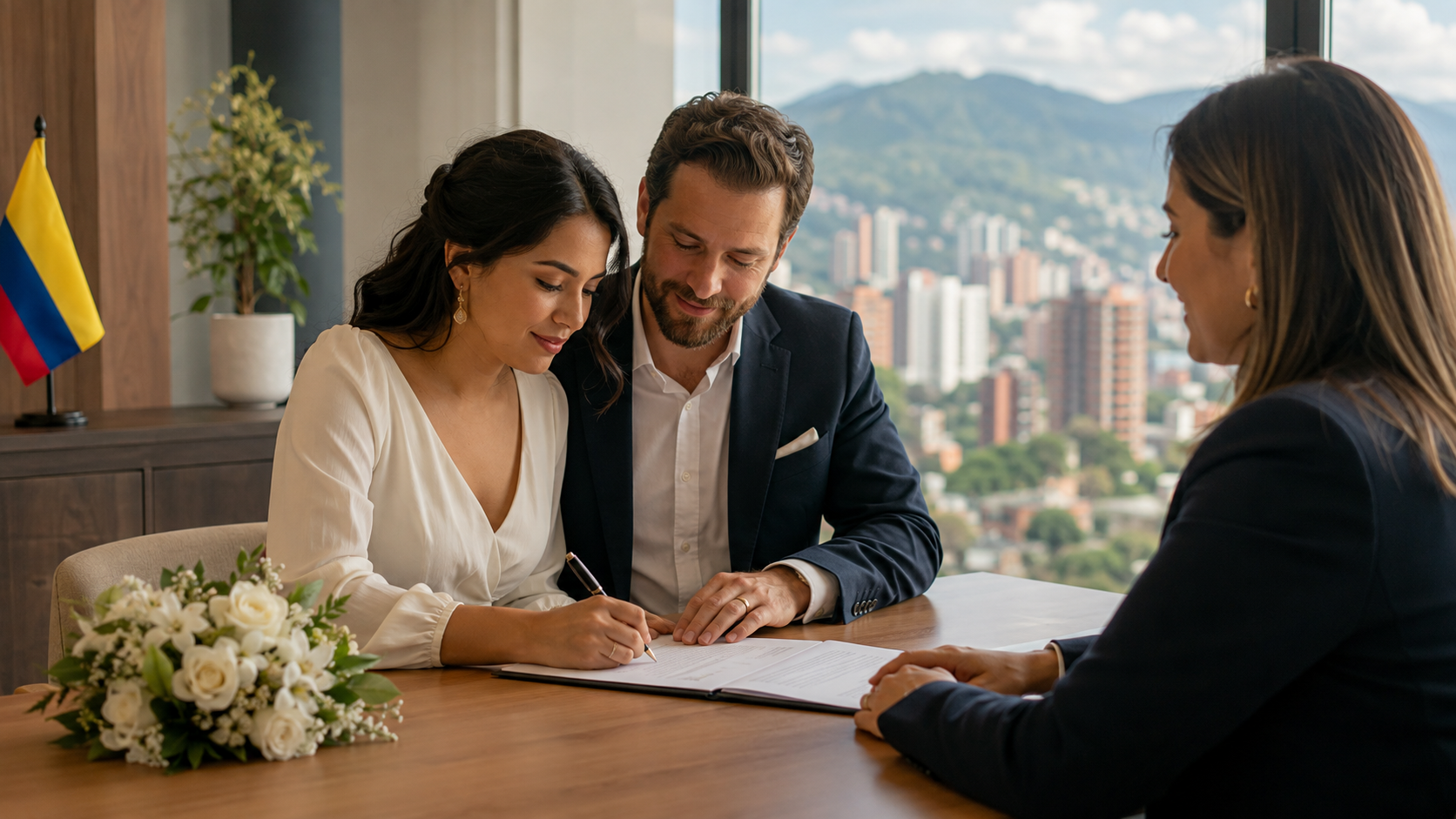
Foreign nationals can legally get married in Colombia, whether they are marrying a Colombian citizen or another foreigner. In most cases, the marriage can be completed before a Colombian notary and formalized through a public deed.
The procedure is relatively straightforward, but foreign documents create additional requirements. Birth certificates, proof of marital status, divorce documents and powers of attorney may need to be recently issued, apostilled or legalized and officially translated into Spanish.
Requirements can also vary depending on the applicants’ nationalities, prior marriages, children, residence and the document-issuing practices of their home countries.
This guide explains the documents, notarial procedure, estimated timeline, 2026 costs and common problems foreigners should consider before getting married in Colombia.
Can a Foreigner Legally Get Married in Colombia?
Yes. Colombian law allows a foreign national to marry:
- A Colombian citizen.
- Another foreign national.
- A same-sex or opposite-sex partner.
Civil marriage in Colombia may be celebrated before a notary or a civil municipal judge. Notarial marriage is normally the preferred option because it is more convenient and generally faster.
A foreigner does not usually need to hold a Colombian residence visa to marry. A valid passport can serve as identification. However, the selected notary may request evidence of the foreigner’s entry into Colombia or current immigration status as part of its administrative review.
Marriage does not regularize an overstay or automatically grant a visa. Immigration status and marital status are separate legal matters.
Both parties must be at least 18 years old. Colombia’s Law 2447 of 2025 prohibits marriages and early unions involving a person under 18.
How Is a Civil Marriage Formalized in Colombia?
A civil marriage before a notary is formalized through a public deed, known in Spanish as an escritura pública de matrimonio civil.
The procedure is governed primarily by Decree 2668 of 1988, as amended. The couple submits a written marriage application and the required supporting documents. The notary reviews the file, completes the applicable notice procedure and schedules the marriage ceremony.
During the ceremony, the parties confirm their free and voluntary decision to marry. The notary authorizes the public deed, and the marriage is subsequently entered into Colombia’s civil registry.
A symbolic ceremony at a hotel, restaurant or wedding venue does not by itself create a legally valid civil marriage. The notarial or judicial procedure must be completed.
Documents Required to Get Married in Colombia as a Foreigner
The exact checklist depends on whether one or both applicants are foreigners and whether either person has been previously married.
Before ordering foreign documents, the couple should ask the selected notary to review the proposed checklist. This is particularly important when the applicant’s country does not issue a traditional certificate of single status.
Documents Required From the Foreign Partner
1. Valid passport
The foreign applicant should provide:
- Original valid passport.
- Clear copy of the passport’s biographical page.
- Copy of the most recent Colombian entry stamp, if requested.
- Cédula de Extranjería, if the foreigner already holds one.
The names in the passport must match the names appearing in the foreign civil documents. Differences involving middle names, surnames, previous married names or spelling should be resolved before filing.
2. Foreign birth certificate
A foreign applicant who is not domiciled in Colombia must generally provide a birth certificate issued by the appropriate civil registry or vital records authority in the country of birth.
Under Decree 2668 of 1988, foreign civil documents used by a non-domiciled foreigner must have been issued less than three months before they are submitted.
The birth certificate must normally be:
- An original or certified copy issued by the competent authority.
- Apostilled if the issuing country is a member of the Hague Apostille Convention.
- Legalized through the applicable consular process if the issuing country is not part of the convention.
- Officially translated into Spanish if issued in another language.
A decorative, hospital or commemorative birth certificate may not be acceptable. The document should be an official civil record.
3. Certificate of single status or equivalent document
The foreign applicant must demonstrate that there is no existing marriage preventing the new marriage.
Depending on the country, the document may be called:
- Certificate of Single Status.
- Certificate of No Impediment.
- Certificate of No Marriage.
- No Record of Marriage Certificate.
- Certificate of Legal Capacity to Marry.
- Affidavit of Single Status.
- Equivalent civil-status certificate.
The document must generally be less than three months old and comply with apostille or legalization and translation requirements.
Not every country has a national civil-status database or issues a standard single-status certificate. In those cases, the notary may accept another document, such as a notarized affidavit or a certificate showing that no marriage record was found in the relevant jurisdiction.
Because the acceptable substitute varies between countries and notarías, it should be approved by the Colombian notary before it is prepared and apostilled.
4. Documents concerning a previous marriage
If the foreign applicant was previously married, the notary will need evidence that the previous marriage legally ended.
Depending on the circumstances, this may include:
- Previous marriage certificate.
- Final divorce judgment or divorce certificate.
- Civil record showing the divorce annotation.
- Annulment judgment.
- Death certificate of the former spouse.
Foreign divorce, annulment and death documents must generally be apostilled or legalized and officially translated.
If the previous marriage was registered in Colombia, the divorce or termination must also be properly recorded in the Colombian civil registry. A divorce judgment issued abroad may require a recognition procedure in Colombia before it can produce effects against a Colombian civil marriage record.
Previous marriages should therefore be reviewed early in the process.
5. Special power of attorney, when applicable
A party may be represented in certain parts of the marriage process through a properly drafted special power of attorney.
The power should:
- Clearly identify both future spouses.
- State the express intention to marry.
- Confirm that there is no known legal impediment.
- Authorize the filing of the marriage application or representation during the permitted stage of the procedure.
- Comply with the requirements of the selected notary.
If the power is signed outside Colombia, it must normally be signed before a Colombian consul or before a foreign notary and then apostilled or legalized. An official Spanish translation may also be required.
Marriage by proxy is highly formal. The couple should not rely on a generic power of attorney.
6. Official Spanish translations
Foreign documents issued in English, French or another language must be translated into Spanish.
The most efficient sequence is generally:
- Obtain the certified foreign document.
- Apostille or legalize the original document.
- Translate both the document and its apostille or legalization into Spanish.
- Submit the complete document package to the Colombian notary.
Translations prepared in Colombia should be completed by an official translator. A translation prepared abroad may require its own authentication, apostille or legalization.
For more information, read our guide to apostilling, legalizing and translating foreign documents in Colombia.
Documents Required From the Colombian Partner
The Colombian partner will generally need:
- Original Colombian cédula de ciudadanía.
- Copy of the cédula.
- Recent authentic copy of the Colombian civil birth record.
- Written marriage application.
- Documents concerning any prior marriage, divorce, annulment or deceased spouse.
- Information about children from previous relationships, when applicable.
Decree 2668 states that the civil birth record submitted with the marriage application should have been issued no more than one month before the application and should be valid for establishing family relationships.
The civil record should contain the necessary marginal notes. If the Colombian partner was previously married, the termination of that marriage and the dissolution of the marital property regime should appear correctly in the relevant records.
What Must the Marriage Application Contain?
The couple must submit a written application to the notary.
The application generally includes:
- Full names of both applicants.
- Identity document or passport numbers.
- Place and date of birth.
- Ages.
- Occupations.
- Current addresses or domicile.
- Names of the applicants’ parents.
- Confirmation that there is no legal impediment to the marriage.
- Confirmation that both applicants freely and voluntarily wish to marry.
- Information about common children, when applicable.
- Information about previous marriages and children from prior relationships.
The application must be presented personally by both applicants or through properly authorized representatives where legally permitted.
Do You Need Witnesses for a Notarial Marriage?
A notarial civil marriage generally does not require the same witness procedure used for a marriage before a judge.
Nevertheless, the notary may establish logistical requirements for the ceremony, especially if it takes place outside the notarial office. The couple should confirm whether guests, interpreters or other participants must provide identification in advance.
If a foreign spouse does not understand Spanish sufficiently to understand the ceremony and public deed, the notary may require an official interpreter.
Step-by-Step Notary Process
Step 1: Select the appropriate notary
The marriage should be filed before a notary with territorial competence based on the domicile of either future spouse.
Notarial practice can differ, especially in cases involving foreign documents. Before obtaining apostilles and translations, send the notary:
- Passport copies.
- Draft copies of the birth certificates.
- Proposed proof of single status.
- Information concerning previous marriages.
- Information about children.
- Any proposed power of attorney.
Obtain written confirmation of the checklist whenever possible.
Step 2: Obtain the foreign civil documents
Request recently issued certified copies of:
- Birth certificate.
- Single-status or no-impediment certificate.
- Divorce or death documents, if applicable.
Document timing is important. A document that becomes older than three months before filing may need to be requested again.
Step 3: Apostille or legalize the documents
Documents from countries participating in the Hague Apostille Convention must usually receive an apostille from the competent authority in the issuing jurisdiction.
Documents from non-member countries must follow the legalization process applicable between the issuing country and Colombia.
An apostille does not certify that the information in the document is true. It authenticates the official signature or seal so the document can be recognized in Colombia.
Step 4: Translate the documents into Spanish
After obtaining the apostille or completing legalization, arrange the official Spanish translation.
Names, dates, certificate numbers and government offices must be translated consistently. The translator should not alter names to make them appear more Spanish.
Step 5: Review prior marriages, children and property issues
Before submitting the marriage application, determine whether the couple needs:
- Proof of divorce or annulment.
- Proof of the former spouse’s death.
- Recognition in Colombia of a foreign divorce judgment.
- A solemn inventory of assets belonging to minor children.
- Prenuptial agreements.
- A special power of attorney.
These additional procedures can significantly affect the timeline.
Step 6: Consider prenuptial agreements
Marriage can create a Colombian marital property regime with important consequences for assets, businesses, investments, income and future acquisitions.
Foreign couples and binational couples should consider whether they need Colombian prenuptial agreements, known as capitulaciones matrimoniales.
Prenuptial agreements must be executed before the marriage. After the marriage ceremony, they can no longer be modified, added to or revoked as prenuptial agreements.
International couples should also consider whether they own property or businesses in more than one country and whether the Colombian agreement will coordinate effectively with their estate and family planning abroad.
Step 7: Submit the marriage application
The couple or their authorized representatives submit the written application and complete document package to the notary.
The notary reviews:
- Identity and legal capacity.
- Validity and age of the civil documents.
- Apostilles or legalizations.
- Official translations.
- Previous marital status.
- Potential legal impediments.
- Territorial competence.
- Powers of attorney.
- Requirements concerning minor children.
Incomplete files are normally returned or held until the missing documents are provided.
Step 8: Complete the public notice period
Once the application satisfies the requirements, the notary posts an edict or public notice for five business days.
The notice includes basic information about the applicants and allows any legally supported objection to be presented before the marriage.
If one applicant is domiciled in another notarial circle or has not lived in the relevant circle for the required period, an additional notice procedure may be necessary. This can extend the timeline.
Step 9: Schedule the ceremony
After the notice period expires without a valid objection, the notary schedules the marriage.
The ceremony may take place:
- Inside the notary’s office.
- At another authorized location, subject to availability and additional fees.
The notary reads or explains the public deed and confirms that both applicants freely consent to the marriage. The deed is signed and authorized in a single act.
Step 10: Register the marriage
After authorizing the public deed, the notary proceeds with the civil registration of the marriage and communicates the marriage to the appropriate civil registry offices for the corresponding annotations.
The couple should obtain:
- A copy of the public marriage deed.
- An authentic copy of the Colombian civil marriage record.
The civil marriage record is the document normally used for visa applications, insurance, inheritance, banking and other legal procedures.
How Long Does It Take to Get Married in Colombia?
The timeline depends primarily on how quickly the foreign documents can be obtained and whether the case involves previous marriages or other complications.
| Stage | Estimated time |
|---|---|
| Obtaining foreign civil documents | 1–8 weeks |
| Apostille or legalization | A few days to several weeks |
| Official Spanish translation | 2–5 business days |
| Notary’s initial document review | 2–5 business days |
| Mandatory public notice | 5 business days |
| Ceremony scheduling | Approximately 1–10 business days |
| Civil registration and copies | Usually shortly after the ceremony |
For a straightforward case with documents already prepared, the notarial process may be completed in approximately two to four weeks.
A more realistic total timeline, including obtaining foreign documents, is four to eight weeks.
The procedure may take longer when:
- A country does not issue a standard single-status certificate.
- A foreign divorce must be reviewed or recognized in Colombia.
- Documents contain inconsistent names or dates.
- A power of attorney is signed abroad.
- A solemn inventory concerning minor children is required.
- Prenuptial agreements must be prepared.
- The notary requires an additional edict.
- One applicant does not speak Spanish.
- The requested ceremony date or location has limited availability.
These timelines are estimates, not statutory guarantees.
How Much Does It Cost to Get Married in Colombia in 2026?
The Superintendence of Notaries and Registry established the following base notarial charges for 2026:
| Notarial service | 2026 base tariff |
|---|---|
| Marriage celebrated inside the notary’s office | COP 64,700 |
| Marriage celebrated outside the notary’s office | COP 174,800 |
These amounts are base tariffs. The final invoice may also include:
- VAT where applicable.
- Notarial paper.
- Copies of the public deed.
- Authentication of signatures.
- Registration or processing of powers.
- Additional pages or documents.
- Official translations.
- Apostilles or legalization.
- Prenuptial agreements.
- Solemn inventory procedures.
- Interpreter services.
- Professional legal assistance.
A civil marriage before a municipal judge does not carry notarial ceremony fees, but it may take longer and will require subsequent registration.
Government tariffs are updated periodically. The amount charged by the notary at the time of filing will control.
Can Two Foreigners Get Married in Colombia?
Yes. Two foreign nationals may marry in Colombia.
Each applicant must generally provide:
- Valid passport.
- Recently issued birth certificate.
- Proof of single status or legal capacity to marry.
- Divorce, annulment or death documents when applicable.
- Apostille or legalization.
- Official Spanish translations.
Territorial competence and the public-notice procedure should be confirmed with the notary, particularly when neither applicant is domiciled in Colombia.
The legal validity of the Colombian marriage in the spouses’ home countries depends on the law of those countries. After the ceremony, the couple may need to obtain an apostilled Colombian marriage record for registration or recognition abroad.
Can a Foreigner Get Married in Colombia While Visiting as a Tourist?
Generally, yes. Colombian residence is not normally required to enter into a valid civil marriage.
However, the foreign applicant still needs enough time in Colombia to:
- Submit the documents.
- Complete the notary’s review.
- Complete the public-notice period.
- Attend the ceremony unless valid representation is accepted.
- Correct any document problem.
The marriage does not extend the foreigner’s authorized stay. A tourist must continue complying with immigration deadlines even while the marriage procedure is pending.
Does Marrying a Colombian Citizen Automatically Grant a Visa?
No. A Colombian marriage and a Colombian visa are separate legal procedures.
After the marriage is registered, the foreign spouse may become eligible to apply for the Migrant Visa for the Spouse of a Colombian National.
The visa application requires, among other documents:
- A recently issued Colombian civil marriage record.
- Request letter from the Colombian spouse.
- Special power of attorney.
- Migratory movement certificates for both spouses.
- Evidence of effective cohabitation when requested.
Marriage does not guarantee visa approval. The Ministry of Foreign Affairs reviews each application individually and may conduct an interview or request additional evidence.
Common Mistakes When Foreigners Get Married in Colombia
Ordering documents before selecting a notary
Different document systems require different solutions. Confirm the notary’s checklist before paying for apostilles and translations.
Using a birth certificate that is too old
Foreign documents for a non-domiciled foreigner generally must be less than three months old. The Colombian civil birth record is subject to a shorter statutory issuance period for the application.
Apostilling the wrong document
The apostille must authenticate the official civil document, not an informal photocopy or hospital certificate.
Translating before obtaining the apostille
The apostille must also be translated. Complete authentication first and translation second.
Assuming every country issues a single-status certificate
Some countries provide certificates of no impediment, while others offer only local searches or sworn affidavits. The substitute must be approved by the notary.
Failing to disclose a previous marriage
A prior marriage must be legally terminated and properly documented. Concealing it can prevent the new marriage or create serious legal consequences.
Ignoring Colombian registration of a foreign divorce
If the prior marriage appears in Colombia’s civil registry, a foreign divorce may need recognition or registration in Colombia.
Waiting until after the wedding to discuss prenuptial agreements
Prenuptial agreements must be executed before the civil marriage.
Assuming the marriage fixes an immigration overstay
Marriage does not erase an immigration violation or automatically regularize the foreign spouse.
Not obtaining the Colombian civil marriage record
The public deed proves the notarial act, but the civil marriage record is the document most commonly required for immigration and other administrative procedures.
Frequently Asked Questions
Do I need a lawyer to get married in Colombia?
A lawyer is not legally required for a standard notarial marriage. Legal assistance may be advisable when the case involves foreign documents, a previous marriage, children, property, powers of attorney or immigration planning.
Do I need a Colombian visa to get married?
A Colombian visa is not generally a substantive requirement for the marriage itself. A valid passport is normally accepted as foreign identification. The notary may request additional immigration or entry information.
Do I need a Cédula de Extranjería?
Not necessarily. A foreign applicant who does not have a cédula can ordinarily be identified with a valid passport.
Must both partners be in Colombia?
Personal participation is the normal procedure. Representation through a special power may be possible in certain circumstances, but the document and ceremony structure must be approved by the notary.
Are witnesses required?
Witnesses are not generally required for a civil marriage before a notary. A judicial marriage follows a different procedure.
Can same-sex couples get married in Colombia?
Yes. Civil marriage is available to same-sex couples under the same general conditions applicable to opposite-sex couples.
Do foreign documents need to be apostilled?
Usually, yes. Documents issued in a Hague Apostille Convention country require an apostille. Documents issued elsewhere generally require legalization.
Do English-language documents need translation?
Yes. Documents issued in a language other than Spanish generally require an official Spanish translation.
How recent must the foreign documents be?
For a foreigner not domiciled in Colombia, the foreign birth certificate and proof of single status must generally have been issued less than three months before submission.
What if my country does not issue a single-status certificate?
The notary may accept an equivalent document, such as a no-record certificate or sworn affidavit. Obtain the notary’s approval before preparing the substitute.
Can I apply for a Colombian marriage visa immediately after the wedding?
The visa application can be prepared after the marriage has been entered into Colombia’s civil registry and a recent authentic copy of the Colombian civil marriage record is available.
Professional Assistance With Marriage in Colombia
International marriage cases often require coordination across several legal and administrative processes.
4 Solutions Group assists foreign and binational couples with:
- Review of foreign birth and marital-status documents.
- Notary selection and document prevalidation.
- Apostille and legalization coordination.
- Official Spanish translations.
- Marriage applications.
- Special powers of attorney.
- Review of previous marriages and divorces.
- Prenuptial agreements.
- Solemn inventories involving minor children.
- Notarial ceremony coordination.
- Colombian civil marriage registration.
- Colombian marriage visa applications.
Preparing the file correctly before traveling or requesting apostilles can prevent unnecessary delays and repeated document expenses.
If you are planning to marry a Colombian citizen or another foreign national in Colombia, contact our team for a personalized document assessment and marriage process plan.
Official Sources
- Colombian Ministry of Justice — Civil Marriage Procedure
- Superintendence of Notaries and Registry — 2026 Notarial Tariffs
- Law 2447 of 2025 — Prohibition of Marriage Under Age 18
- National Civil Registry — Civil Marriage Registration
- Decree 2668 of 1988 — Civil Marriage Before a Notary
This article provides general information and does not constitute individualized legal advice. Notarial requirements may vary according to the applicants’ circumstances, nationality, prior marital status and the documents issued by their country of origin.
 Contact us or request an appointment for professional advisory services.