
Last updated: June 2026
Foreign investors acquiring real estate, contributing capital to a Colombian company or participating in another qualifying investment must understand Colombia’s foreign exchange registration rules.
Registering foreign investment is not merely an administrative formality. A properly registered investment may allow a non-resident investor to exercise important foreign exchange rights, including the ability to remit profits abroad, repatriate capital and prove the existence of the investment for certain Colombian visa procedures.
The correct registration method depends primarily on how the investment was completed.
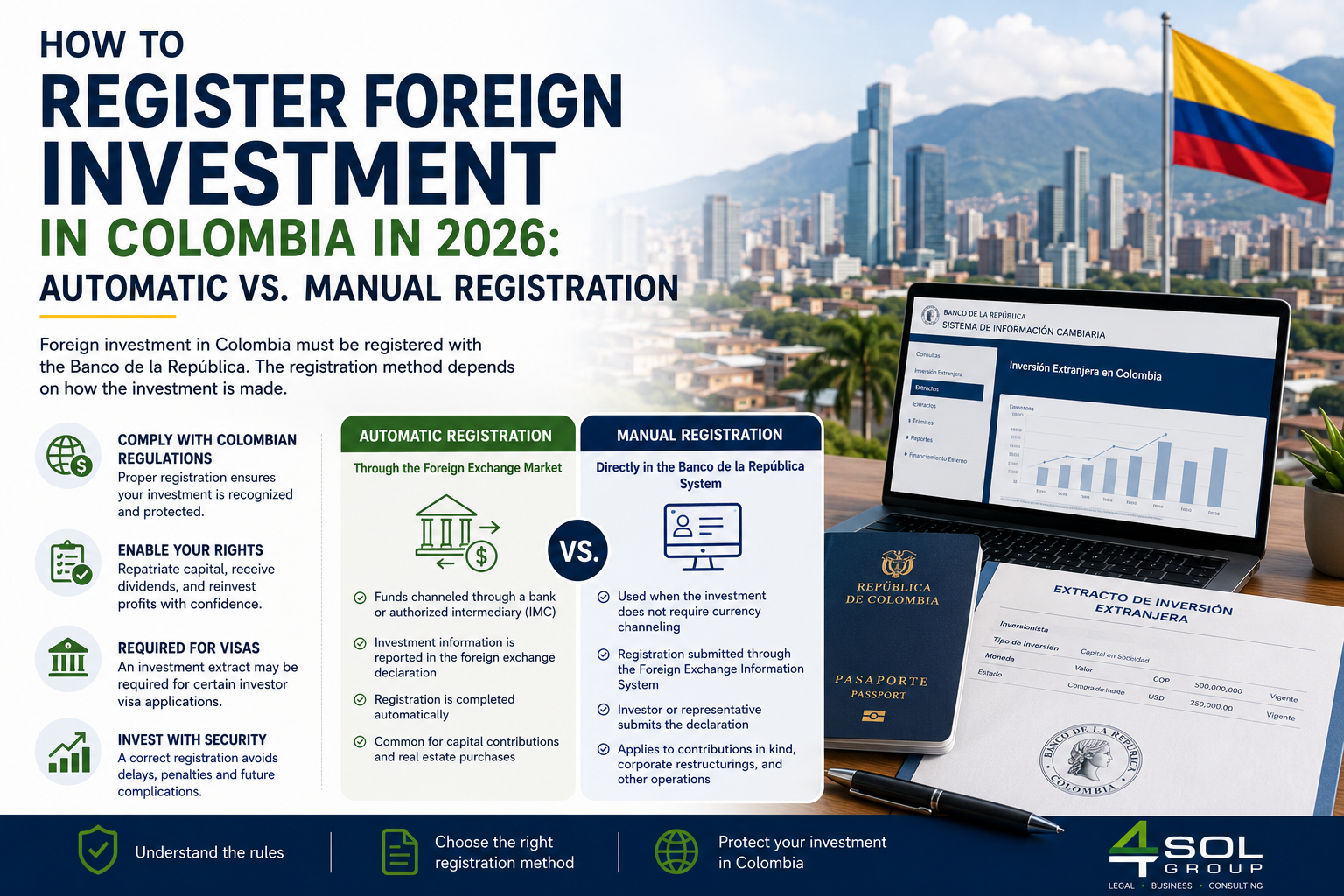
In some cases, registration occurs automatically when foreign currency is properly transferred through Colombia’s foreign exchange market. In other cases, the investor or the Colombian company receiving the investment must complete a direct registration through the Banco de la República’s Foreign Exchange Information System.
This guide explains the difference between automatic and manual foreign investment registration in Colombia in 2026.
What Is Foreign Investment in Colombia?
Foreign investment generally refers to an investment made by a person or company considered a non-resident for Colombian foreign exchange purposes in an asset, company or qualifying investment located in Colombia.
Common examples include:
- Purchasing shares or quotas in a Colombian company
- Contributing capital to a Colombian simplified stock corporation, or SAS
- Increasing the capital of a Colombian company
- Purchasing real estate in Colombia
- Acquiring rights in a trust or fiduciary structure
- Contributing assets or rights to a Colombian company
- Capitalizing certain amounts owed to a foreign investor
- Participating in eligible portfolio investments
It is important to distinguish foreign exchange residency from immigration or tax residency.
A person may hold a Colombian visa, live temporarily in Colombia or have tax obligations in Colombia while still receiving different treatment under the foreign exchange regulations.
The investor’s status must therefore be reviewed under the applicable foreign exchange rules rather than assumed solely from nationality, visa status or tax residence.
Why Must Foreign Investment Be Registered?
The registration identifies:
- The foreign investor
- The Colombian company or asset receiving the investment
- The amount invested
- The currency and exchange value
- The type and destination of the investment
- The date of the transaction
- The method used to complete the investment
A properly registered investment may support the investor’s ability to:
- Reinvest profits
- Remit profits and dividends abroad
- Receive funds from the sale of the investment
- Repatriate capital
- Receive funds following a capital reduction
- Receive liquidation proceeds
- Demonstrate the investment before Colombian authorities
- Obtain an investment extract for certain visa applications
Registration also creates consistency between the financial transaction, the company’s corporate records, its accounting records and the information reported to the Banco de la República.
What Is the Difference Between Automatic and Manual Registration?
The terms “automatic registration” and “manual registration” are widely used in professional practice.
More precisely, the difference is between:
- Registration completed through the proper channeling of foreign currency through the foreign exchange market.
- Registration transmitted directly through the Banco de la República’s Foreign Exchange Information System when the operation does not require the channeling of foreign currency.
The correct route depends on the legal and economic structure of the investment.
Automatic Foreign Investment Registration
Foreign investment is generally registered automatically when foreign currency is properly channeled through:
- A Colombian bank or another authorized Foreign Exchange Market Intermediary, known as an IMC; or
- A duly registered compensation account
The investor does not normally need to submit a separate foreign investment registration after the transfer when all required information was correctly provided during the exchange transaction.
The foreign exchange declaration effectively serves as the investment registration declaration.
How automatic registration works
A typical automatic registration follows this sequence:
- The foreign investor sends money from abroad.
- The funds enter Colombia through a bank or authorized foreign exchange intermediary.
- The receiving party informs the intermediary that the transfer corresponds to a foreign investment.
- The required minimum foreign investment information is supplied.
- The intermediary converts or processes the funds and transmits the information.
- The investment becomes registered based on the foreign exchange declaration.
Typical automatic registration examples
Automatic registration commonly applies when:
- A foreign shareholder sends money to subscribe for shares in a Colombian SAS.
- A foreign investor sends funds to capitalize an existing Colombian company.
- A foreign buyer transfers funds through the foreign exchange market to purchase Colombian real estate.
- A non-resident investor sends funds for another qualifying direct investment in Colombia.
The exact investment code and transaction information must match the actual legal purpose of the transfer.
Information Required for Automatic Registration
The Colombian bank or foreign exchange intermediary may request information such as:
- Investor’s full legal name
- Investor’s country of residence
- Investor’s identification number
- Type of investor
- Name and identification of the Colombian recipient
- Amount transferred
- Currency
- Purpose of the transfer
- Type of investment
- Destination of the investment
- Information concerning the Colombian company or property
The bank may also request supporting documents as part of its compliance procedures, including:
- Passport or corporate documents
- Share subscription documents
- Company certificates
- Purchase agreements
- Certificates of corporate existence and legal representation
- Evidence of the source of funds
- Tax identification information
- Beneficial ownership information
The documents requested by the bank for compliance purposes are not necessarily the same as the information legally required for the foreign exchange registration.
A Bank Transfer Is Not Automatically an Investment Registration
One of the most common mistakes made by foreign investors is assuming that every international transfer into Colombia automatically becomes a registered foreign investment.
That is incorrect.
The registration will only be accurate when:
- The transaction is channeled through the appropriate mechanism
- The correct foreign exchange concept is selected
- The investor is properly identified
- The Colombian recipient is correctly identified
- The transaction is reported as an investment
- The purpose of the funds matches the legal documents
- The minimum investment information is transmitted correctly
A transfer may reach a Colombian bank account but still be reported as:
- A family transfer
- Payment for services
- Reimbursement
- Loan
- Donation
- Other transfer
- Incorrect investment category
In these circumstances, the bank receipt alone may not prove that a valid foreign investment registration exists.
What Is Manual Foreign Investment Registration?
“Manual registration” commonly refers to the direct transmission of a Declaration of Registration of International Investments through the Banco de la República’s Foreign Exchange Information System.
This procedure generally applies to qualifying investments that do not require the channeling of foreign currency through the foreign exchange market.
The investor, an authorized representative or, in certain circumstances, the legal representative of the Colombian recipient company may transmit the registration.
The registration must correspond to one of the permitted legal origins established by the applicable foreign exchange regulations.
When Is Manual Registration Required?
Manual registration may be required when the investment is completed through a lawful operation that does not involve a foreign currency transfer requiring channeling through the foreign exchange market.
Depending on the specific transaction, examples may include:
- Contributions in kind
- Contributions of tangible assets
- Contributions of intangible assets
- Certain capitalizations
- Corporate reorganizations
- Mergers or demergers
- Exchanges of shares
- Acquisitions resulting from contracts or lawful operations without an incoming foreign currency transfer
- Certain investments involving trusts or fiduciary rights
- Other authorized non-currency origins
The legal origin selected in the system must accurately reflect how the investor acquired the asset or participation.
Not every operation without an international bank transfer qualifies for manual registration.
Manual Registration Cannot Repair an Incorrectly Channeled Transfer
This distinction is critical.
Manual registration applies to investments that legally do not require the channeling of foreign currency.
It is not a general correction mechanism for money that:
- Entered Colombia outside the required foreign exchange channel
- Was sent to the wrong recipient
- Was reported under an incorrect transaction concept
- Was treated as a loan instead of an investment
- Was treated as payment for services
- Entered through an unrelated personal account
- Was converted without the required investment information
Where the transaction should have been channeled as foreign investment, transmitting a manual registration does not automatically cure the original foreign exchange noncompliance.
The correct solution may require:
- Correcting the foreign exchange declaration
- Changing transmitted information
- Annulment and retransmission
- Reviewing the bank’s transaction record
- Filing a special request
- Restructuring the corporate transaction
- Obtaining a formal legal and foreign exchange assessment
How to Complete a Manual Registration
The process generally involves the following steps.
Step 1: Determine whether the operation qualifies
Review the investment transaction and determine whether it is an investment that does not require the channeling of foreign currency.
The transaction must correspond to an authorized registration origin.
Step 2: Review the investor’s status
Confirm that the investor was a non-resident for Colombian foreign exchange purposes when the investment was made.
Step 3: Identify the Colombian recipient
The recipient may be:
- A Colombian company
- A Colombian trust or autonomous estate
- A real estate investment
- Another eligible recipient or asset
The recipient’s legal and tax identification must be accurate.
Step 4: Review the corporate and contractual documents
Depending on the transaction, the documents may include:
- Shareholders’ meeting minutes
- Board decisions
- Share subscription agreements
- Capitalization agreements
- Assignment agreements
- Merger documents
- Trust agreements
- Asset contribution documents
- Share certificates
- Company accounting records
- Certificates of ownership
Although the system may not require supporting documents to be uploaded with every registration, the investor and the Colombian recipient must retain evidence proving the legality and accuracy of the transaction.
Step 5: Access the Foreign Exchange Information System
The investor or authorized user must access the Banco de la República’s Foreign Exchange Information System.
Where a representative files the registration, the appropriate representation or authorization must be established in the system.
Step 6: Complete the registration declaration
The user must provide information concerning:
- Investor
- Recipient
- Investment destination
- Investment origin
- Transaction date
- Amount
- Currency or valuation
- Percentage or participation, where applicable
- Other information required for the selected investment type
Step 7: Review the transmitted information
Before transmitting, confirm that the information matches:
- Corporate records
- Accounting records
- Contracts
- Share certificates
- Tax documents
- Property documents
- The actual economic transaction
Step 8: Obtain the transaction confirmation
After transmission, retain the confirmation and verify that the investment appears correctly in the investor’s foreign investment extract.
Is There a Deadline for Registering Foreign Investment?
For investments without channeling of foreign currency that qualify for direct registration, the Banco de la República currently states that the registration may be transmitted at any time.
However, this does not mean the transaction should be left unregistered indefinitely.
Delaying registration may cause difficulties when the investor needs to:
- Apply for an investor visa
- Prove the amount invested
- Distribute dividends abroad
- Sell the investment
- Repatriate capital
- Correct company records
- Complete due diligence
- Demonstrate the origin of the investment
Other procedures, such as cancellation or substitution of a registered investment, may be subject to specific deadlines.
The transaction should therefore be reviewed and registered promptly.
What Is an Investment Extract?
The investment extract is the document generated through the Banco de la República’s Foreign Exchange Information System showing the foreign investments associated with an investor or recipient.
It may include information such as:
- Investor identification
- Recipient identification
- Registered amount
- Type of investment
- Investment destination
- Registration movements
- Cancellations
- Substitutions
- Current recorded balance
The Banco de la República does not generally issue a separate certification letter for an investor visa. The investor must obtain the investment extract through the system.
Foreign Investment Registration and Colombian Investor Visas
Foreign nationals applying for certain Colombian investor visas may need to demonstrate that their investment has been registered with the Banco de la República.
Depending on the visa category, the investment may involve:
- Real estate
- Shares or quotas in a Colombian company
- Direct capital contributions
- Other qualifying investment structures
The visa authority may review more than the value shown in the investment extract.
It may also examine:
- The legal ownership of the investment
- The source and route of the funds
- Corporate documents
- Shareholder certificates
- Accounting records
- Property certificates
- Bank documents
- Foreign exchange declarations
- Whether the investment remains in place
A registered amount does not by itself guarantee visa approval.
The immigration documents, corporate records and foreign exchange information must be consistent.
Example 1: Capital Contribution Through a Colombian Bank
A US citizen decides to invest COP 200 million in a Colombian SAS.
The investor transfers US dollars from a US bank account to the Colombian company’s bank account.
The company informs the Colombian bank that the transfer is a foreign direct investment for the acquisition of shares.
The bank requests the investor’s identification, the company’s information and the investment purpose.
If the correct minimum investment information is transmitted, the registration occurs automatically.
No separate manual registration should normally be required.
Example 2: Money Transferred Under the Wrong Concept
A Canadian investor sends funds to a Colombian company.
However, the Colombian bank processes the transfer as payment for services instead of foreign investment.
The company subsequently issues shares to the investor.
Although the company’s corporate documents show a capital contribution, the foreign exchange transaction may not appear as a registered investment.
A manual registration should not be filed automatically to cover the problem.
The original transaction and foreign exchange declaration must first be reviewed to determine whether a correction, change, annulment or another procedure is required.
Example 3: Contribution of Equipment
A foreign company contributes machinery to a Colombian company in exchange for shares.
No foreign currency is transferred through a Colombian bank.
Because the investment is made through an asset contribution rather than an incoming currency transfer, it may require direct registration through the Foreign Exchange Information System under the corresponding authorized origin.
The customs, corporate, accounting and valuation documents must be consistent with the declared investment.
Example 4: Capitalization of an Existing Obligation
A Colombian company owes a qualifying amount to its foreign shareholder.
The parties agree to capitalize that amount and issue shares instead of making payment.
Depending on the origin of the obligation and the structure of the transaction, the capitalization may qualify for registration without channeling foreign currency.
The underlying obligation, corporate approval and accounting treatment must be reviewed before selecting the applicable registration origin.
Example 5: Purchase of Real Estate
A foreign buyer sends funds from abroad to acquire an apartment in Colombia.
For automatic registration, the funds should be channeled under the correct foreign investment concept, identifying the buyer as the investor and the real estate investment as the destination.
The following should be consistent:
- International transfer
- Foreign exchange declaration
- Promise of purchase
- Public deed
- Certificate of title
- Purchase price
- Investor identification
- Investment extract
Sending money directly to a seller, intermediary, trust, family member or unrelated account may require additional review.
How to Verify Whether an Investment Was Registered Correctly
The investor should not rely only on:
- A SWIFT receipt
- A Colombian bank statement
- A currency exchange receipt
- A share certificate
- A public deed
- A company accounting entry
Instead, the investor should obtain and review the investment extract.
The extract should be compared against:
- Amount actually transferred
- Amount converted into Colombian pesos
- Corporate capital increase
- Number of shares acquired
- Property purchase price
- Investor’s legal name
- Investor’s identification
- Colombian recipient
- Investment destination
- Transaction date
Any inconsistency should be reviewed before the investment is used for a visa, sale, dividend distribution or capital repatriation.
Automatic vs. Manual Registration: Comparison
| Issue | Automatic registration | Manual registration |
|---|---|---|
| Main mechanism | Channeling foreign currency | Direct online declaration |
| Filing route | Bank, IMC or compensation account | Foreign Exchange Information System |
| Separate registration normally required | No | Yes |
| Typical operation | Incoming foreign currency investment | Investment without required currency channeling |
| Registration basis | Foreign exchange declaration | International investment registration declaration |
| Supporting documents | Commonly requested by bank | Generally retained by investor and recipient |
| Can it fix an improperly channeled transfer? | Correction may be possible | No, not by itself |
| Main risk | Incorrect transaction concept | Incorrect legal origin |
Common Foreign Investment Registration Mistakes
1. Sending the money before obtaining legal advice
The investor transfers funds without first determining:
- Who should receive the money
- What investment concept should be used
- Whether the funds are capital, a loan or a purchase price
- What corporate documents must be signed
- Whether the investment will support a visa
Once the money has entered under the wrong structure, correcting the transaction may become significantly more complex.
2. Using a personal account for a corporate investment
Funds intended for a Colombian company are sent to:
- A shareholder’s personal account
- A lawyer’s account
- An employee’s account
- A family member’s account
- An unrelated intermediary
This can create inconsistencies between the payment route and the legal investment recipient.
3. Confusing a shareholder loan with a capital contribution
A loan and an equity investment are legally and financially different.
They have different:
- Contracts
- Corporate effects
- Accounting treatment
- Foreign exchange reporting
- Repayment rights
- Visa implications
4. Increasing company capital without matching the foreign exchange record
The company registers a capital increase with the Chamber of Commerce, but the incoming funds were not correctly reported as foreign investment.
Corporate registration alone does not replace foreign investment registration.
5. Treating the manual procedure as a universal correction tool
An investor attempts to register any prior transaction manually, even though the funds should originally have been channeled through the foreign exchange market.
This may create an additional inconsistent record without correcting the original noncompliance.
6. Using inconsistent identification information
Differences in:
- Names
- Passport numbers
- Nationality
- Corporate names
- Tax numbers
- Recipient information
may prevent the investment from appearing correctly in the extract.
7. Failing to update the registration after a corporate transaction
The investment may later be affected by:
- Sale of shares
- Assignment
- Merger
- Change of recipient
- Capital reduction
- Company liquidation
- Change in investment destination
These events may require a cancellation or substitution procedure.
Corrections, Changes and Annulments
Incorrect information transmitted through an intermediary or a compensation account may be subject to procedures involving:
- Correction
- Change
- Annulment
- Retransmission
- Special requests
The correct procedure depends on:
- The original filing route
- The type of mistake
- The date of the transaction
- Whether the investor or recipient changes
- Whether the transaction itself changed
- Whether funds were actually channeled
- Whether the investment already appears in the system
The investor should avoid creating duplicate records while attempting to correct an error.
Cancellation of Foreign Investment
A cancellation generally occurs when a registered investment is reduced or extinguished because the investor ceases to own all or part of it.
Examples may include:
- Sale of shares
- Sale of real estate
- Capital reduction
- Company liquidation
- Repayment following an eligible reduction
- Termination of rights in a trust
- Other lawful disposal of the registered investment
A cancellation requires an existing registered investment.
Substitution of Foreign Investment
A substitution generally involves a change in:
- The investor
- The Colombian recipient
- The destination of the investment
For example, a substitution may arise when shares are transferred from one foreign investor to another.
Cancellation and substitution procedures are generally subject to different rules and deadlines from the original registration.
Documents Foreign Investors Should Retain
Foreign investors should maintain an organized file containing:
- Passport or corporate identification documents
- Proof of foreign exchange residency
- International transfer confirmations
- SWIFT messages
- Colombian bank receipts
- Foreign exchange declarations
- Share subscription agreements
- Shareholders’ meeting minutes
- Capital increase documents
- Chamber of Commerce certificates
- Share certificates
- Share registry records
- Accounting certificates
- Public deeds
- Property certificates
- Trust certificates
- Investment extracts
- Corrections and special requests
- Powers of attorney
These documents may be needed several years after the original investment.
Practical Checklist Before Sending Investment Funds
Before transferring money to Colombia, confirm:
- Who is legally making the investment?
- Is the investor a non-resident for foreign exchange purposes?
- What asset or participation will be acquired?
- Who must legally receive the money?
- Is the transaction equity, debt, a property purchase or another operation?
- Must the foreign currency be channeled through the foreign exchange market?
- What investment concept should be used?
- What documents must be signed before the transfer?
- Does the investment need to support a Colombian visa?
- Will the amount satisfy the applicable visa threshold?
- Do the corporate documents match the amount being transferred?
- Who will verify the final investment extract?
Frequently Asked Questions
Do I always need to file a separate registration with the Banco de la República?
No. When foreign currency is properly channeled through an authorized intermediary or compensation account and the required investment information is supplied, registration generally occurs automatically.
Is every international transfer automatically registered as foreign investment?
No. The transfer must be correctly identified and reported as an investment.
When is direct or manual registration used?
It is generally used for qualifying investment operations that do not require the channeling of foreign currency.
Can I manually register money that entered Colombia incorrectly?
Not necessarily. Direct registration does not automatically correct a transaction that should have been channeled through the foreign exchange market.
Does the Banco de la República issue a visa certificate?
The investor generally obtains an investment extract through the Foreign Exchange Information System rather than requesting a separate certification letter.
Can a lawyer register the investment for the investor?
An authorized representative may complete certain procedures, provided the representation requirements are properly established.
Does registration guarantee an investor visa?
No. The Ministry of Foreign Affairs independently evaluates the visa application, the value and continuity of the investment and the supporting documents.
Can an old investment still be registered?
Certain investments without channeling may be registered at any time, but the underlying operation must qualify. An old incorrectly channeled transaction requires a separate legal analysis.
What happens when I sell the investment?
A cancellation or substitution may be required depending on the transaction and the identity of the buyer.
How 4Sol Group Can Help
At 4Sol Group, we assist foreign investors with the legal, corporate, foreign exchange and immigration aspects of investing in Colombia.
Our services may include:
- Reviewing the proposed investment structure
- Determining whether registration will be automatic or direct
- Coordinating the investment with the Colombian bank
- Reviewing the correct foreign exchange concept
- Preparing company capital increases
- Drafting shareholder and corporate documents
- Registering qualifying investments through the Foreign Exchange Information System
- Reviewing existing investment records
- Correcting inconsistent investment information
- Preparing cancellation or substitution procedures
- Obtaining and reviewing investment extracts
- Coordinating foreign investment registration with investor visa applications
- Assisting with real estate purchases and title due diligence
- Supporting the repatriation of capital and profits
Foreign investment planning should take place before the funds are transferred.
A properly structured transaction helps ensure that the bank transfer, corporate documents, accounting records, property documents, foreign exchange registration and immigration strategy all reflect the same legal operation.
Contact 4Sol Group before sending investment funds to Colombia or if you need to review an investment that may not have been registered correctly.
Legal notice: This article provides general information and does not constitute legal, tax, accounting, financial or foreign exchange advice. Colombian foreign exchange treatment depends on the structure, date, parties, residency status, payment route and supporting documents of each transaction.
 Contact us or request an appointment for professional advisory services.